How to Air-Dry Laundry Indoors Without Trading Energy Savings for Condensation
A drying rack can reduce use of a tumble dryer, but the water in the laundry does not disappear when the clothes feel dry. Indoors, it moves into the air and must leave through ventilation or be collected by equipment that removes moisture. If the room cannot manage that extra water, cold windows and walls may become the place where it collects.
The useful question is whether your home can support the load you are asking it to dry. A few lightweight garments in a suitable ventilated space and several heavy towels in a closed bedroom are different jobs. Start with a manageable load and observe the room as well as the clothes, so saving a dryer cycle does not quietly create another household problem.
Check what happens in the room before buying anything
Notice whether windows become wet during drying, whether garments take unusually long to dry and whether corners or the space behind furniture smell musty. Those observations do not diagnose every cause of damp, but they tell you that the current arrangement needs attention. A room that stays damp on days without laundry may have another moisture source as well.
The EPA recommends keeping indoor relative humidity below 60 percent where possible, ideally between 30 and 50 percent. A humidity meter can help you follow the room’s pattern, although a single reading beside an open window is not a complete assessment. Record the location and conditions when you read it, and pay attention to condensation on cold surfaces even when a room-average reading seems acceptable.
Make a short note before hanging the load, during drying and after the garments have dried. Include whether doors and windows were open, whether outdoor conditions were damp and whether cooking or bathing added moisture nearby. This is a practical household observation log, not a building survey; it is useful because it lets you compare a change against the same room’s ordinary behaviour.
Remove water before it reaches the rack
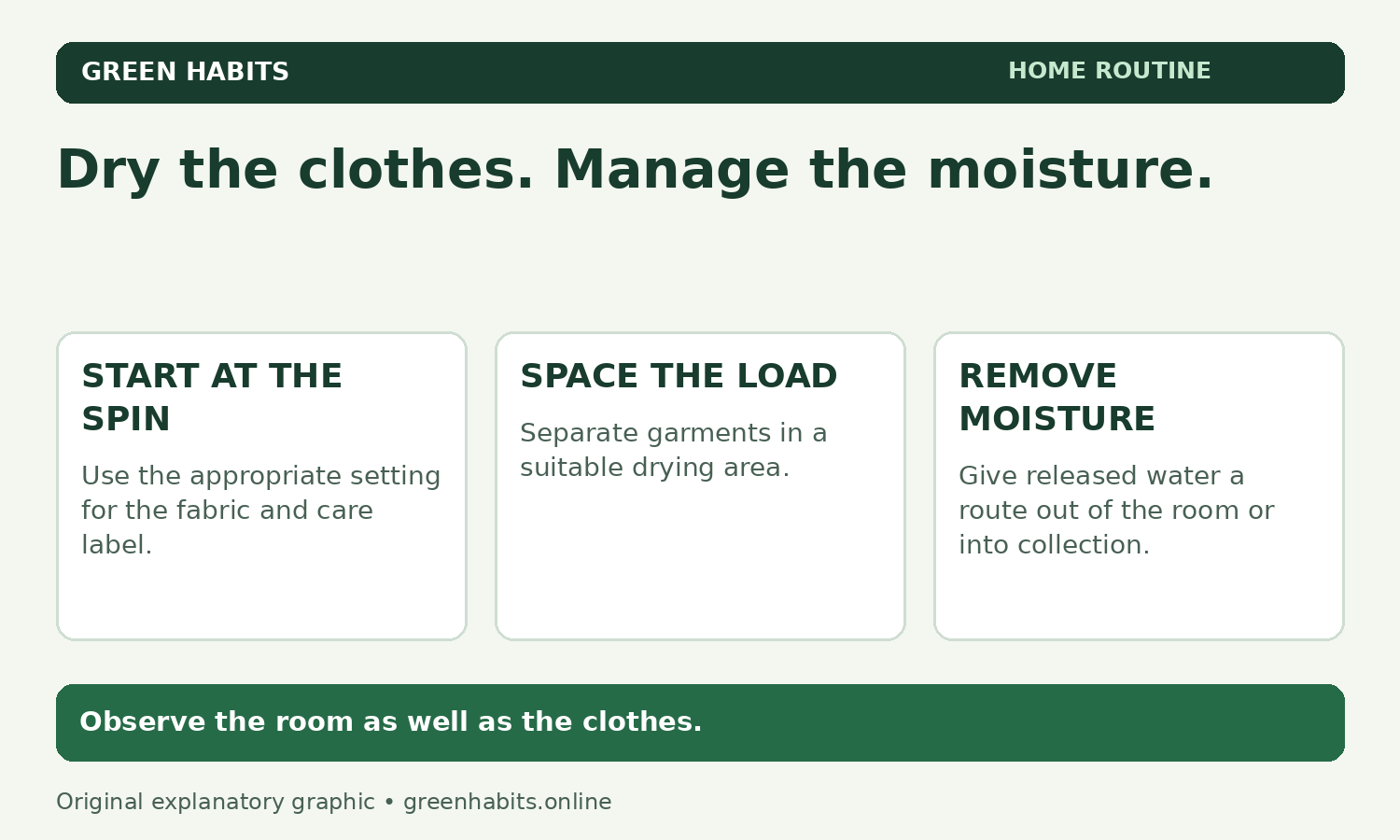
Use the washing machine’s appropriate final spin for the fabric and the care label. More vigorous spinning is not suitable for every garment, so the aim is to use the machine correctly rather than select its highest speed indiscriminately. A balanced load and the correct programme help avoid starting the drying job with unnecessarily wet laundry.
Shake garments out and untangle sleeves before hanging them. Leave space between items and avoid folding thick fabric into several wet layers on the rack. A towel draped over multiple bars is a different drying arrangement from a towel compressed between two other towels, even when both occupy the same corner of the room.
Separate items that dry quickly from ones likely to remain wet much longer. If lightweight shirts are dry but a dense towel is still damp, do not let the shirts keep occupying useful space while waiting for everything to finish together. Sorting the drying job can be simpler than adding a fan or appliance to compensate for an overcrowded rack.
Give the moisture a route out
A room with suitable extraction to the outdoors can be a better candidate than one where humidity has nowhere to go. Confirm what the fan actually does: a recirculating device is not the same as an extractor that discharges outside. Keep vents clear and follow the building’s ventilation guidance rather than covering an inconvenient opening to make the room feel warmer.
| Stage | What happens? |
|---|---|
| Wet fabric | Water remains in the clothes after washing. |
| Room air | Evaporation transfers that water into the air. |
| Suitable ventilation | A route carries moisture outdoors. |
| Suitable dehumidification | Equipment removes and collects moisture. |
A fan moves air around the garments and may help evaporation, but moving air does not by itself remove water from the home. Heating can also help the drying process without completing the moisture-removal job. Both can be useful parts of the arrangement when ventilation or dehumidification gives the released water somewhere else to go.
There is no universal instruction to open every window for a fixed number of minutes. Security, rain, outdoor humidity, heating needs and the building’s ventilation system all affect what is practical. Use an approach suited to the home, and judge it by whether clothes dry reliably without a persistent damp-room pattern.
Choose the space and load together
Keep the rack away from cold walls and avoid wedging it behind furniture where air movement is restricted. Use a space that can manage the moisture and still function safely, with clear routes through the room. Do not put damp laundry over electrical equipment, on heaters or where the appliance’s instructions prohibit it.
A single suitable drying space is easier to monitor than racks scattered across bedrooms and living areas. That does not make every closed room suitable: concentrating wet laundry without a moisture-removal route simply concentrates the problem. Where the building’s ventilation design depends on transfer air through doors or grilles, follow that design rather than applying a blanket instruction to shut every door.
Consider a hypothetical bedroom where two large loads hang overnight and the window is wet each morning. The first experiment could be reducing the amount dried indoors and moving the rack to a space with appropriate extraction. Compare the room conditions before and after; adding more heat while keeping the same wet load and no removal route would leave the central question unanswered.
Use a mixed drying routine when conditions need it
You do not have to commit every item to the same method. Lightweight garments may dry well on a rack while heavy towels need a tumble dryer during a persistently damp period. Choosing by fabric, weather and available space can reduce unnecessary machine drying while respecting what the home can handle.
A dehumidifier may be useful where indoor drying is regular and other moisture-control options are limited. Check its operating range, room suitability, placement, drainage and electrical instructions before use. It consumes electricity, so its value depends on the problem it solves; treating it as free drying because it is not a tumble dryer would overlook part of the resource use.
For example, a household could air-dry everyday shirts, machine-dry suitable thick towels and use the ventilated drying space for one load at a time. That is an illustrative compromise, not a measured saving or a rule for all buildings. It can be a more durable arrangement than attempting to dry everything indoors and repeatedly dealing with damp garments or wet windows.
Watch for a building problem that laundry cannot explain
A patch that becomes wet after rain, a plumbing leak or persistent damp unrelated to drying deserves separate investigation. Note where it appears and when, and report building defects to the appropriate owner or repair service. GreenHabits’ small-leak guide can help you record plumbing clues without assuming every wet surface comes from condensation.
If visible mould or a persistent musty smell has developed, address the moisture source as well as the affected material. Hiding the patch behind a rack or painting over it does not solve the water problem. Extensive, recurring or hidden damp needs appropriate professional assessment; the drying trial should not delay a necessary repair.
Make the next load a useful trial
Choose one ordinary load and set it up with the correct spin, space between garments and a suitable moisture-removal route. Record whether the room develops condensation and how reliably the clothes dry. Change one factor for the next comparable load so you can understand whether the improvement came from less laundry, better placement or better ventilation.
Keep the method that fits the building and the fabrics rather than forcing a particular definition of a green routine. The laundry-care guide connects drying with wash frequency, loading and garment care. A routine that keeps clothes useful and the home dry is easier to maintain than one that saves a cycle but leaves damp problems behind.