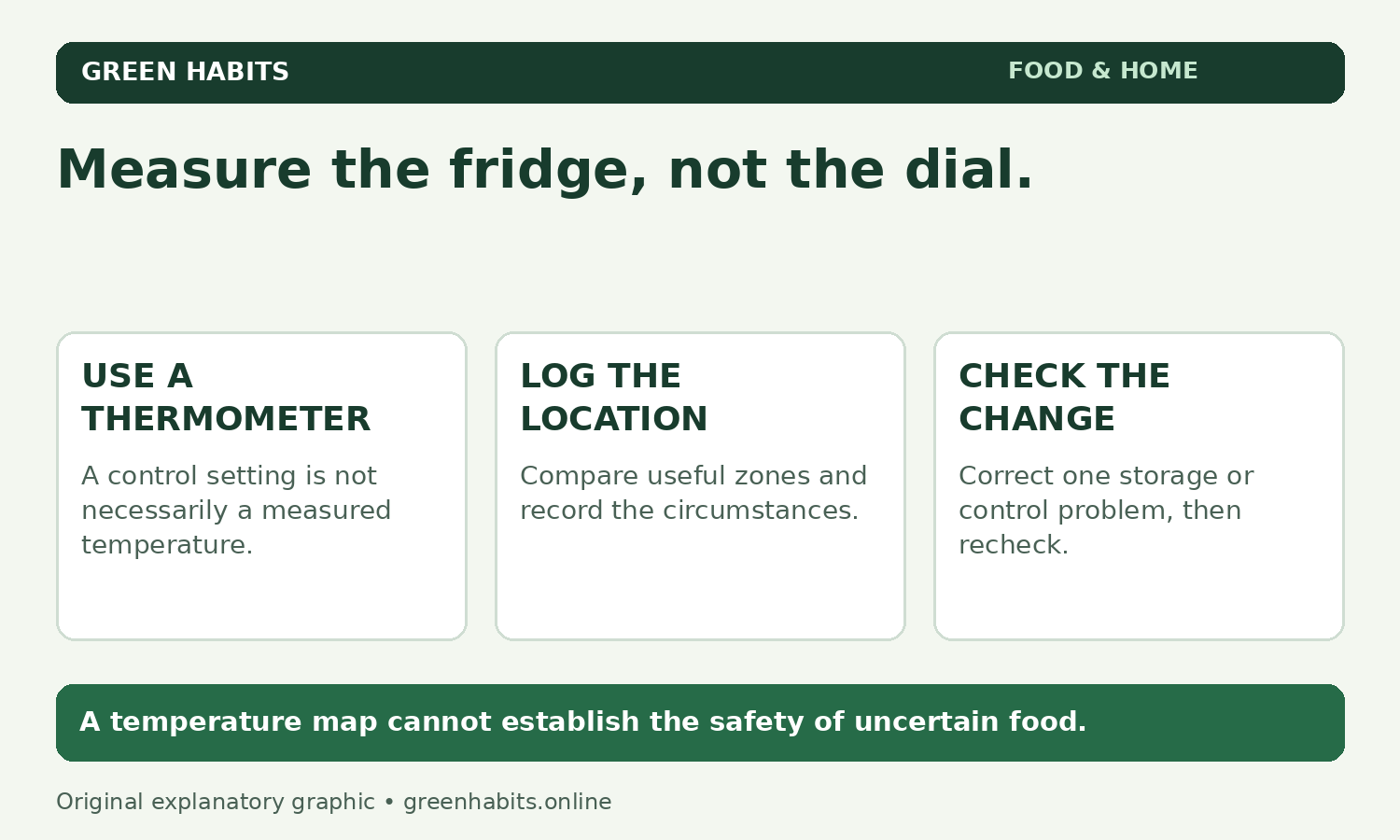
Your Fridge Dial Is Not a Temperature Reading: Build a Food-Safe Temperature Map
The number beside a refrigerator dial is usually a control setting, not a measurement of the food compartment. A setting marked “3” does not necessarily mean 3°C, and moving the dial can have a different effect on different models. Before changing storage habits or buying a replacement appliance, check what temperature the refrigerator is actually maintaining.
A thermometer can also reveal a more specific problem than “the fridge is wrong.” Lettuce freezing near the rear and food staying too warm in another area may require different responses. A small temperature map helps you see those differences, but it does not turn uncertain food into safe food or replace the appliance’s storage instructions.
Establish the safety baseline first
The FDA recommends a refrigerator temperature of 40°F (4°C) or below and a freezer temperature of 0°F (-18°C). Use a suitable appliance thermometer and follow its instructions for positioning and settling time. Touching a shelf or reading a control dial cannot establish whether the compartment is maintaining the recommended temperature.
If the refrigerator has clearly failed to keep perishables cold, deal with food safety before continuing the mapping exercise. A cool reading now does not show how long food was warm earlier, and smell or appearance cannot settle that question. Follow food-specific safety guidance when the temperature history is uncertain rather than tasting an item to decide whether it survived.
For a refrigerator that is operating normally, begin with one accessible reference position recommended by the appliance or thermometer instructions. Note the dial setting, date, reading and whether the door was recently open. This gives you a starting point without pretending that a single number describes every shelf under every condition.
Map a few useful zones
Choose locations that answer an actual storage question. You might compare the centre shelf, an area where produce has frozen and the door shelf holding frequently used items. Those are observation points, not a universal map assigning one temperature to every refrigerator; models differ in airflow, drawers and temperature-controlled compartments.
- Location: identify the exact zone you are checking.
- Reading: allow the thermometer to settle as instructed.
- Conditions: record normal use, loading and recent openings.
- Follow-up: make one useful correction and recheck.
No shelf temperature is assumed in this observation plan.
If you have one thermometer, move it between locations and allow it to settle according to its instructions. Try to compare similar ordinary conditions and make clear that the readings were taken at different times. Multiple suitable thermometers can compare locations together, but small differences between instruments should not be mistaken for a detailed laboratory map.
Do not keep opening the door to watch the instrument. Record readings during normal access and note unusual conditions such as a large grocery load or repeated door openings. The point is to understand normal storage well enough to make a useful change, not to create a long series of readings dominated by the act of checking them.
Use a log that includes the circumstances
A temperature without its context can lead to the wrong correction. A reading just after groceries were loaded is different from one taken after a stable period, while a rack of containers pressed against an air outlet may explain a local issue. A short observation log gives you enough detail to compare those situations.
| Date and location | Reading | What changed? | Action to check |
|---|---|---|---|
| Centre shelf | Record the settled reading | Usual load; normal access | Use as a reference |
| Area where produce froze | Record the reading | Note distance from vents and rear surfaces | Try a suitable alternative position |
| Door shelf | Record the reading | Note frequent openings | Review what is stored there |
| After a grocery load | Record and recheck as appropriate | Note new containers and possible obstruction | Restore the manual’s required airflow |
Keep storage time in the same decision. A suitable shelf does not give leftovers an unlimited life, and an old label is not corrected by lowering the dial. Use dates and the food’s storage instructions along with temperature; the leftovers guide deals with that part of the routine.
Correct the storage arrangement before chasing the dial
Find the cold-air outlets and any loading limits shown in the manual. Avoid packing containers so tightly that the intended circulation is obstructed, and keep packages from preventing drawers or the main door from closing properly. A tidy shelf is useful only if it also respects the appliance’s airflow and storage design.
If produce freezes in one location while appropriate food elsewhere is staying safely chilled, moving the freeze-sensitive items may be a more targeted first step than warming the whole refrigerator. For a hypothetical example, imagine herbs repeatedly freezing near a rear outlet while a suitable reference reading remains within the recommended range. Moving the herbs to an appropriate produce area and observing the result answers a specific question without guessing that every shelf is too cold.
The door is another area worth checking rather than assuming it is equivalent to an interior shelf. The FDA advises storing eggs in their carton inside the refrigerator rather than in the door. Follow the product label and appliance guidance for other foods, and reserve convenience positions for items suited to those conditions.
Make control changes slowly and deliberately
Read which direction makes your model colder before turning the dial. Make an adjustment within the manufacturer’s guidance, then allow the stated stabilisation time before deciding whether it worked. Repeated large adjustments can make it difficult to know which setting produced the result you are seeing.
A display is useful, but understand what it reports. Some controls show a selected target, while others provide a measured temperature; the manual should clarify the distinction. An independent suitable appliance thermometer is a practical check when the control’s meaning is unclear, and the displayed target alone should not settle an unresolved food-safety concern.
If the compartment remains too warm after basic loading and closing problems are corrected, seek service rather than endlessly turning the control. Write down the model, settings, readings and conditions to help explain the fault. Documenting the problem is more useful than describing the refrigerator simply as “not very cold.”
Keep food visible without creating a new cold spot
A “use first” group can help the household find leftovers and opened food, provided it occupies an appropriate location and does not obstruct airflow. Choose a container or label that keeps the food visible without turning a crowded shelf into a tightly packed box. Separate raw foods and ready-to-eat foods according to safe handling practice.
Use the map to answer practical questions rather than add permanent clutter. Which suitable area is easiest for everyone to see? Where can a container fit without blocking an outlet? Which produce needs a different position because it keeps freezing? The produce-storage guide helps match visibility with the needs of the food.
Recheck when the conditions change
Keep periodic temperature checks in the routine, and pay particular attention after a control adjustment, a large rearrangement or a change in appliance behaviour. If groceries regularly create an overcrowding problem, reconsider the shopping and storage plan instead of treating every Friday’s packed shelves as a reason to select a colder setting.
Finish the first map with one correction and a follow-up check: move the freeze-sensitive produce, clear an obstructed outlet or address a door that will not shut correctly. Keep the readings that explain the decision and discard the rest of the paperwork. A useful map leads to safer, more workable storage; it does not need to become a permanent project.
Reference
FDA — Refrigerator Thermometers: Cold Facts About Food Safety