When a Dishwasher Saves Water—and When Your Routine Cancels the Savings
A dishwasher’s efficiency rating describes the appliance, while your kitchen routine determines how much washing happens before and after its cycle. A machine can be economical on paper and still sit beside a tap that runs for several minutes before every load. Looking at the complete job is more useful than deciding that either the dishwasher or hand washing is always the greener choice.
Start with the machine you already own. Notice what goes into it, how much preparation happens at the sink, which cycle you use and whether items come out clean enough to avoid a second wash. The aim is a reliable routine that uses the appliance’s capacity well, rather than a rigid rule that makes a small lunch plate wait several days for a supposedly perfect load.
Compare one complete washing job
A hand-washing comparison depends on whether you fill a basin, run the tap continuously or repeatedly refill hot water. The dishwasher comparison depends on its model, cycle, loading and preparation at the sink. Without knowing those conditions, a saving quoted for a different household cannot predict your result.
ENERGY STAR advises scraping rather than pre-rinsing and running full loads when practical. Its guidance also explains that cycle choices and heated-dry options affect resource use. Those are useful starting points, but your manufacturer’s instructions determine how to operate and maintain the particular machine in your kitchen.
Think of one meal’s cleanup as a single job: food removal, loading, washing, drying and any rewashing. If dishes need a second pass because bowls shielded one another from the spray, the first cycle’s low consumption is only part of the story. Keeping a quick note of failed items can reveal a loading problem that a new detergent or longer programme would otherwise hide.
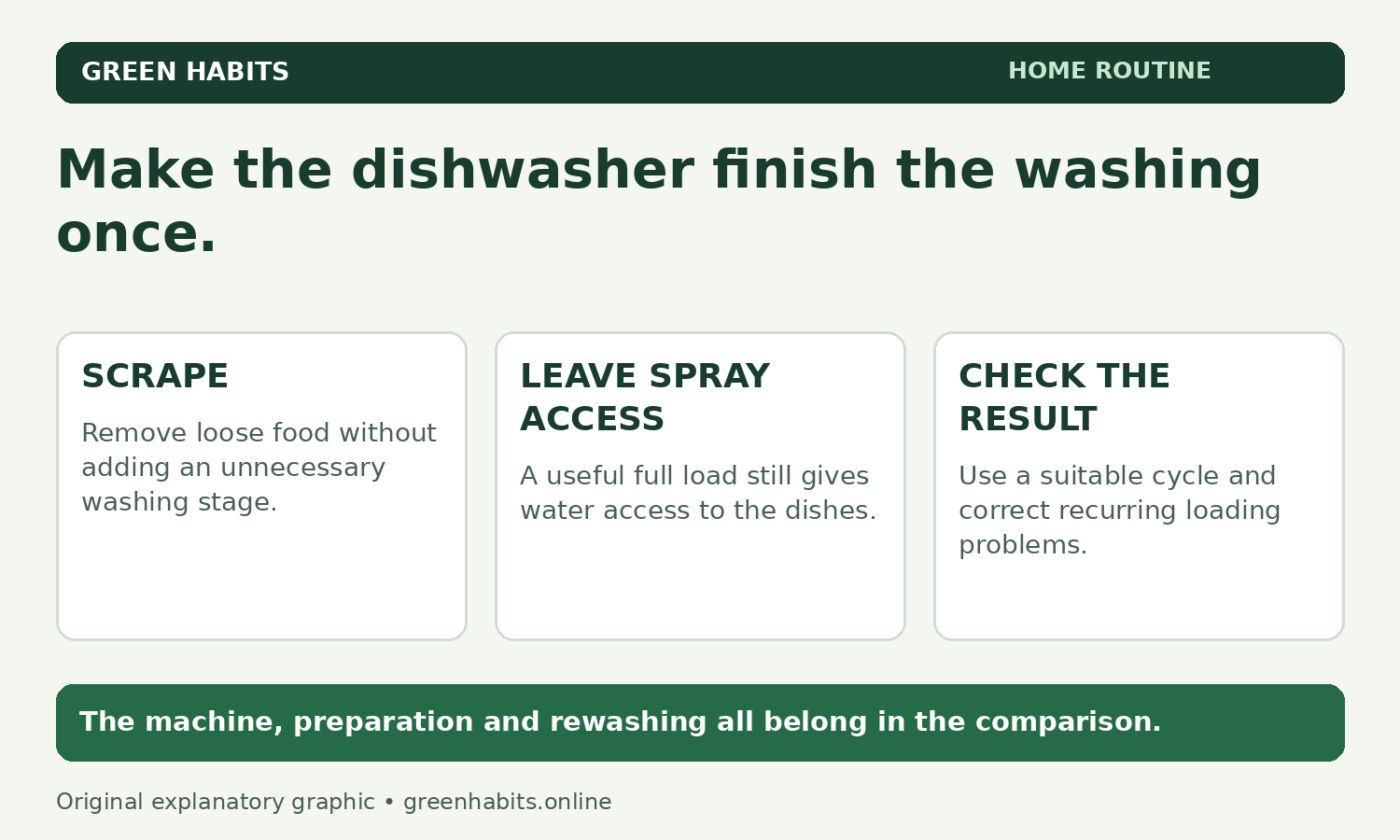
Give scraping a fair trial
Remove loose food into the appropriate waste stream, then load the dishes according to the manual. Check the rules for compost locally rather than assuming cooked food belongs in every compost system. For ordinary loads in a machine designed to handle scraped dishes, a long hot-water pre-rinse adds a separate washing stage before the actual wash begins.
If something repeatedly emerges dirty, isolate that problem. A badly positioned bowl, a filter needing maintenance or an unsuitable programme will not necessarily improve because every plate was rinsed more thoroughly. Burnt-on food may need model-appropriate treatment, but one difficult saucepan is a reason to address that saucepan, not an automatic reason to rinse every item in the kitchen.
Here is an illustrative example rather than a measured saving: a family switches from running hot water over each dinner plate to scraping the plates and loading them correctly. They keep the same suitable cycle and check the result. If cleaning remains reliable, they have removed a whole preparation step without needing a claim about a fixed number of litres saved.
Fill the racks without blocking the wash
The useful load is the largest one your machine can clean properly, not the largest number of dishes you can physically squeeze inside. Deep bowls can shelter surfaces behind them, large trays can obstruct the spray, and utensils can nest together. Follow the rack layout in the manual and check that spray arms can move freely before starting.
- Prepare: scrape loose food; follow instructions for difficult items.
- Load: leave the required spray paths and arm movement clear.
- Wash: choose a programme suited to the actual load.
- Review: notice failed items before adding a second wash.
Place a troublesome item differently on the next normal load instead of changing several things at once. If the same corner repeatedly comes out dirty, check what sits above or in front of it. When loading becomes a testable arrangement rather than a contest to fit one more cup, it is easier to identify whether the problem is positioning, soil or the machine.
Some materials and finishes should not go in a dishwasher at all. Respect the item’s care instructions as well as the appliance manual; saving water is a poor trade if washing damages a useful utensil. Hand washing a few unsuitable items can be part of an efficient household routine without turning the entire meal’s cleanup into a hand-washing job.
Fit the schedule to the household
A person who uses a handful of dishes a day has a different scheduling problem from a large family. Running an almost empty machine every evening may leave useful capacity unused, but waiting indefinitely for a full load can also become unpleasant or impractical. Choose a reasonable interval that fits hygiene, odour control, the manual and the dishes you actually need.
Suppose six items are washed every night even though the next day’s items would fit comfortably into the same racks. A trial of fewer, better-filled loads may make sense if the household can store scraped dishes appropriately and still has what it needs. This is an illustrative scheduling decision, not a guarantee that every combined load uses exactly the same resources as the original ones.
For one mug and a knife needed again immediately, an efficient small hand wash may be simpler. Avoid leaving the hot tap running while you deal with unrelated kitchen tasks. The decision is about finishing the real washing job well, including very small jobs, rather than meeting a rule about always using one method.
Choose a suitable cycle before choosing the shortest one
The programme names on different machines are not directly interchangeable. Read what your model’s normal, eco, quick and intensive programmes are intended to do, and compare the stated water and energy figures where the manual provides them. Elapsed time alone cannot tell you which programme uses fewer resources or will clean the current load well.
Reserve intensive treatment for loads that need it instead of making it the default for every lightly soiled cup. Equally, a quick programme that leaves items needing another wash has not finished the job. A programme trial is most useful when the loading, detergent and typical soil remain similar enough to understand what changed.
Heated drying is a separate choice where the machine offers it. Some households value ready-to-put-away dishes; others can use the model’s approved air-drying option. Consider the result and the manual rather than opening a hot machine in an improvised way, especially where children, pets or a busy kitchen make hot steam a problem.
Maintenance is part of the routine
Check whether the model has a user-serviceable filter and follow its cleaning schedule. Look for obstructed spray-arm holes or a load that prevents an arm from rotating, but do not dismantle components beyond the instructions. Use detergent intended for automatic dishwashers and dose it according to the product, appliance and local water conditions.
Repeated poor cleaning, leaking or a persistent error needs investigation rather than endless rewashing. Document the cycle, load and error before requesting service. The repair-or-replace checklist helps keep that decision grounded in the actual fault and available repair, rather than age alone.
For the next week, make one change you can judge: remove unnecessary pre-rinsing, correct one recurring loading mistake or combine suitable small loads. Check cleanliness and convenience before keeping it. The most useful improvement is one that finishes the washing once and fits ordinary kitchen life.